Clinical-strength antiperspirants can reduce sweat by 60-80%. Most people get closer to 20% — not because the product failed, but because they're using it the wrong time of day, in the wrong amount, on the wrong skin state. Here's the protocol that dermatologists and the International Hyperhidrosis Society both recommend.
The core rule: apply at night, not in the morning
This single change is the biggest swap most people have never been told. Clinical-strength antiperspirants work by forming an aluminum-salt gel plug inside the sweat duct. The plug takes 6-8 hours of low-sweat conditions to fully form. If you apply in the morning and immediately go about your day, the sweat glands start firing before the plug is stable — and most of the active washes off in shower form by evening.
At night, sweat-gland output drops to its daily minimum (confirmed in circadian-output studies of human sweat glands). Apply before bed, let it sit while you sleep, and by morning the plug is fully seated. You then get a full day of reduced sweat — plus the plug persists for 24-48 hours.
The full nightly protocol
1. Shower or clean the area — and let it dry completely
If the skin is damp when you apply, the aluminum compound dissolves in the surface water and washes off instead of binding to the duct opening. Towel off, then wait 5-10 minutes before applying. The skin needs to feel fully dry to the touch.
2. Apply a thin, even layer
More is not more. A thin, even coverage over the entire underarm works as well as a thick layer and causes less irritation. For a gel format like the Duradry Sweat Minimizing Gel, two or three thumbnail-sized dabs spread evenly is plenty.
3. Let it dry before putting on a shirt or going to bed
This is non-negotiable. Wet antiperspirant transferred to fabric is antiperspirant that's no longer in the duct. Wait 2-3 minutes until the product has fully dried on skin.
4. Start with 3-5 consecutive nights
The plug builds up. Day 1 of a new protocol reduces sweat by maybe 30%. Days 3-5 hit full efficacy. Don't judge a product on one application.
5. Taper to maintenance
Once the plug is seated (usually after the first week of nightly use), you can taper to every other night, then every 2-3 nights. Published protocols suggest this minimizes irritation while keeping efficacy high. If sweat returns, go back to nightly for 3-4 days, then taper again.
The four common mistakes
Mistake 1 — Applying in the morning because "I need it for today"
Understandable instinct; wrong timing. If you need it today, apply in the morning and tonight — but the tonight application is what actually builds protection for tomorrow. Morning-only application maxes out at around 20-30% reduction, no matter how strong the product.
Mistake 2 — Exfoliating right before applying
Scrubs, chemical exfoliants (AHA/BHA), or loofahs under the arms strip the stratum corneum — the plug lives in the stratum corneum. Skip exfoliation on application nights. Keep exfoliation to one day a week, and apply antiperspirant on a different night.
Mistake 3 — Stopping too soon
"I tried it for three days and it didn't work." Efficacy tracks plug development. Commit to at least 5-7 nights before judging the product. If after a full 7-day protocol you're still sweating through, you've either got a strength that's too low for your situation (step up to maximum-strength OTC or see a dermatologist for prescription Drysol) or a secondary form of hyperhidrosis that needs medical workup.
Mistake 4 — Applying over broken or just-shaved skin
Aluminum chloride on compromised skin causes stinging and can worsen irritation. If you've just shaved, wait 24 hours. If you have a cut or rash, skip that area until it heals.
Managing irritation
Some irritation is normal in the first few days. The AAD's guidance is that mild redness or stinging usually resolves within a week of consistent use. If irritation is persistent or severe:
- Step down strength — try clinical-strength (aluminum zirconium) before maximum-strength (aluminum chloride)
- Apply to slightly-moisturized skin (contrary to the dry-application rule for unirritated skin). A thin layer of a simple lotion, let it absorb, then antiperspirant over top.
- Take a 2-3 night break and restart with a different formulation
- If irritation is severe (blistering, weeping, spreading), stop and see a dermatologist
When to reach for combination products
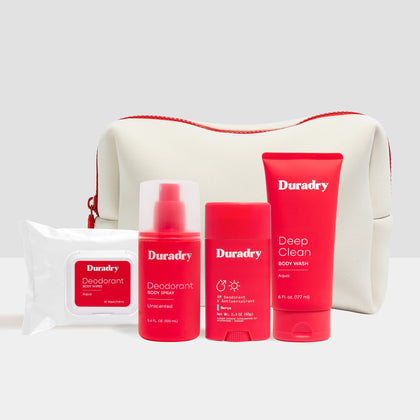
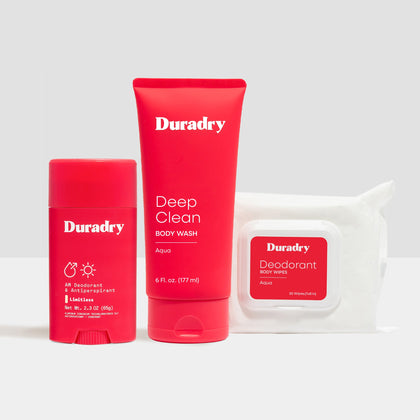
The Duradry 3-Step System is designed around this whole protocol: Step 1 is the nightly antiperspirant (the right-time application). Step 2 is a morning deodorant (odor control without stripping the nightly plug). Step 3 is an antibacterial body wash that supports odor management without exfoliating away the plug. Treat it as a routine, not three independent products.
If you'd rather use one product, a combination antiperspirant-deodorant stick (like ours) gives up some night-application optimization in exchange for morning convenience. Typical efficacy lands around 40-50% reduction instead of 60-80%.
For body areas beyond the underarm
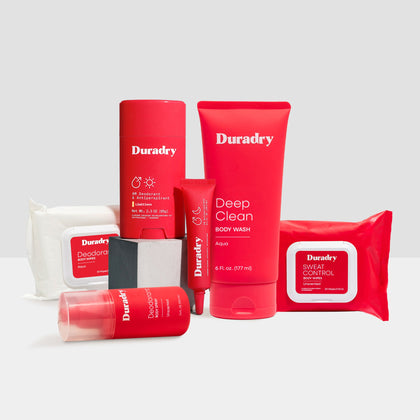
The same protocol applies to feet, groin, and under-breast areas — nighttime, dry skin, let-it-set. For hard-to-reach or large-surface areas, Duradry Whole-Body Antiperspirant Wipes are designed to apply evenly without transfer. The active is still aluminum-based; the delivery format just suits the body area better.
Related reading
- How to stop excessive sweating — complete hyperhidrosis guide — the OTC-to-Rx ladder and when to see a dermatologist.
- Antiperspirant vs deodorant — why "natural deodorant" didn't solve your sweat problem.
The Duradry lineup used in this protocol
- Sweat Minimizing Gel — maximum-strength aluminum chloride, for nightly application.
- 3-Step System — antiperspirant + morning deodorant + body wash.
- Whole-Body Antiperspirant Wipes — non-stick body areas.
- The full Duradry lineup.
References
- International Hyperhidrosis Society — How to Apply Antiperspirant — International Hyperhidrosis Society (accessed 2026-04-22)
- Aluminum chloride antiperspirant — systematic review of protocols — PubMed / J Am Acad Dermatol (accessed 2026-04-22)
- American Academy of Dermatology — Antiperspirant application and skin irritation — American Academy of Dermatology (accessed 2026-04-22)
- Sweat gland physiology and circadian output variation — NIH / PubMed Central (accessed 2026-04-22)
Discover more from Duradry or browse the full Duradry collection.
Frequently asked
What does "How to Use Clinical Antiperspirant Correctly (Why Most People Do It Wrong)" cover?
This piece walks through the topic, context, and practical implications laid out in the article body above — focused on giving you a clear, sourced read rather than a quick listicle. Use it to deepen your understanding of the brand, category, or product family discussed.
Who is this article written for?
Readers shopping the brand or category covered, plus curious browsers researching independent makers stocked at Curated Sense. Both casual shoppers and trade buyers will find the same source-linked perspective.
How does Curated Sense vet the brands featured in journal articles?
Every brand in our journal has been onboarded directly: live inventory sync with the brand's own catalog, links back to the maker's own .com, and quality checks against return-rate, fulfillment-time, and customer-message-volume thresholds. We don't run sponsored placements in our journals.
Where can I shop the products discussed in this article?
Open the brand's collection or sub-collection page linked above to see current stock. Each product card opens a full Curated Sense product page with sizing, materials, the maker's own description, and the brand's live shipping policy.
EDITOR'S PICK
Active Body Set
The clinical-strength antiperspirant set our team tested: nighttime aluminum chloride lotion, AM/PM deodorant, and body wash. 60-80% effective when applied per the AAD method described above.
Shop Duradry →Shop the Duradry edit
Authentic, brand-direct Duradry — free US shipping over $75. Browse Duradry at Curated Sense →