They sit next to each other on the shelf. They look identical. One is an FDA-regulated drug and the other is a cosmetic. Using the wrong one is why most people's sweat problem "isn't being solved by anything." Here's exactly what each product does, and a simple rule for which one you need.
The one-line answer
Antiperspirants block sweat. Deodorants mask odor. They do completely different things.
If you use a deodorant and wonder why your shirts are still wet, that's because the deodorant never promised to stop sweat in the first place. If you use an antiperspirant and still have odor, that's because most antiperspirants have weaker fragrance than standalone deodorants — and odor has a bacterial source the antiperspirant isn't reaching.
Most people need both. Most people buy one.
The regulatory difference (which tells you everything)
Under FDA rules, antiperspirants are drugs. Deodorants are cosmetics. That distinction maps directly to what they're allowed to claim:
- An antiperspirant affects a body function (sweat). Drugs must prove efficacy, have a defined active ingredient, and list that ingredient in a "Drug Facts" box. Published in 21 CFR 350.
- A deodorant affects scent only. Cosmetics don't need Drug Facts boxes, don't need to list active ingredients, and can't claim to reduce sweat.
Check any label: if the product has a Drug Facts panel listing "Active ingredient: Aluminum [chloride/zirconium/chlorohydrate]" — it's an antiperspirant. If it doesn't have that panel — it's a deodorant. That's the most reliable distinction.
What antiperspirant actually does
The aluminum compound in antiperspirant dissolves in sweat, forms a gel plug inside the sweat duct, and physically blocks sweat from reaching the skin surface. The plug holds for 24-48 hours until the outer skin cells naturally shed. Efficacy by class, from the peer-reviewed systematic review cited below:
- Regular-strength aluminum chlorohydrate: ~20% sweat reduction
- Clinical-strength aluminum zirconium: ~50% sweat reduction
- Maximum-strength aluminum chloride gel: 60-80% sweat reduction
- Prescription aluminum chloride (Drysol): 80%+ reduction
The Duradry Sweat Minimizing Gel sits in the maximum-strength OTC bracket.
What deodorant actually does
Deodorant ingredients work on odor, which is actually a bacterial byproduct. Sweat itself is nearly odorless; bacteria on skin metabolize sweat compounds (specifically apocrine-gland secretions under the arms) and produce the smell. Deodorants interrupt that process by:
- Adjusting skin pH so bacteria can't thrive — baking soda, magnesium hydroxide
- Adding fragrance to mask residual odor — essential oils or synthetic fragrance
- Binding odor molecules — ingredients like saccharomyces ferment or zinc ricinoleate
- Adding mild antibacterials — triclosan (largely phased out), some essential oils, prebiotics
Deodorant does not reduce sweat. It reduces the odor produced from sweat.
Why "natural deodorant" didn't work for you
This is the complaint we hear more than any other. "Natural deodorant" is almost always a deodorant-only formulation — no aluminum, no sweat blocking. It uses baking soda, magnesium, or arrowroot to control odor, and that works reasonably well for people with normal sweat output.
But if you have hyperhidrosis, no amount of odor control fixes a wet shirt. What you needed was antiperspirant. The switch to natural deodorant failed because it wasn't the same category of product.
This isn't a knock on natural deodorants. It's a knock on labeling that makes them look interchangeable with antiperspirants when they're regulated as a different class of product.
When to use which — the simple decision tree
- Do you have wet underarms after getting dressed? You need an antiperspirant.
- Do you have odor but no visible sweat? You need a deodorant.
- Both? Apply antiperspirant at night (the right time — see our application protocol guide), and deodorant in the morning on top. They layer — the antiperspirant dries before the deodorant goes on.
Can one product do both?
Yes — many stick and roll-on products combine an aluminum active ingredient (antiperspirant) with fragrance and antibacterial additives (deodorant). The FDA allows this as a combination drug + cosmetic, and it's the most common format on shelves. The Duradry Antiperspirant Deodorant Stick is an example — aluminum zirconium active plus a fragrance and bacterial-control layer.
Combination products are convenient but have a trade-off: the night-application rule is stronger for pure antiperspirants than for combos, because combos are formulated to apply in the morning and the plug-forming is less deep.
About aluminum safety
The American Academy of Dermatology has addressed the question directly: the published evidence does not support a causal link between aluminum antiperspirants and breast cancer or Alzheimer's disease. These claims circulated widely in the 2000s but are not supported by the peer-reviewed literature. Read their direct statement (cited below). If you still prefer aluminum-free, that's a valid personal preference — just understand you're choosing a product that won't reduce sweat volume, only odor.
Related reading
- How to stop excessive sweating: complete hyperhidrosis guide — the OTC-to-Rx ladder for serious sweat issues.
- How to use clinical antiperspirant correctly — why night application matters.
The Duradry lineup referenced here
- Antiperspirant Deodorant Stick — combination drug + cosmetic format.
- Sweat Minimizing Gel — maximum-strength aluminum chloride, nightly application.
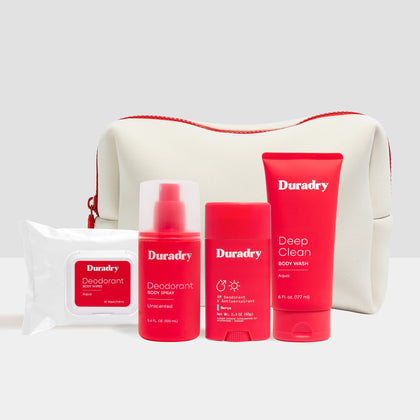
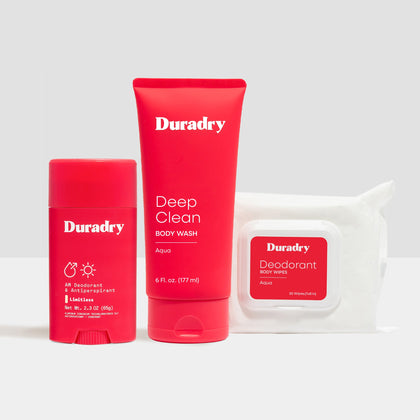
- 3-Step System — antiperspirant + deodorant + body wash, both jobs separately.
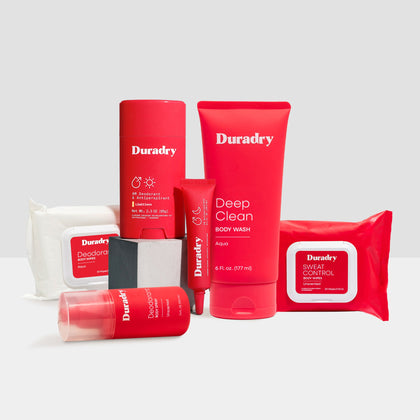
- The full Duradry lineup.
References
- FDA Antiperspirant Drug Products OTC Monograph (21 CFR 350) — US Food and Drug Administration (accessed 2026-04-22)
- FDA — Is It a Cosmetic, a Drug, or Both? — US Food and Drug Administration (accessed 2026-04-22)
- Aluminum-based antiperspirants — systematic efficacy review — PubMed / J Am Acad Dermatol (accessed 2026-04-22)
- American Academy of Dermatology — Antiperspirants and deodorants — American Academy of Dermatology (accessed 2026-04-22)
Discover more from Duradry or browse the full Duradry collection.
Frequently asked
What does "Antiperspirant vs Deodorant: What's the Difference, and Which Do You Actually Need?" cover?
This piece walks through the topic, context, and practical implications laid out in the article body above — focused on giving you a clear, sourced read rather than a quick listicle. Use it to deepen your understanding of the brand, category, or product family discussed.
Who is this article written for?
Readers shopping the brand or category covered, plus curious browsers researching independent makers stocked at Curated Sense. Both casual shoppers and trade buyers will find the same source-linked perspective.
How does Curated Sense vet the brands featured in journal articles?
Every brand in our journal has been onboarded directly: live inventory sync with the brand's own catalog, links back to the maker's own .com, and quality checks against return-rate, fulfillment-time, and customer-message-volume thresholds. We don't run sponsored placements in our journals.
Where can I shop the products discussed in this article?
Open the brand's collection or sub-collection page linked above to see current stock. Each product card opens a full Curated Sense product page with sizing, materials, the maker's own description, and the brand's live shipping policy.
EDITOR'S PICK
Active Body Set
Need both the sweat-blocker (antiperspirant) and the odor-masker (deodorant)? Duradry's Active Body Set bundles aluminum chloride night lotion + AM/PM deodorant + body wash.
Shop Duradry →Shop the Duradry edit
Authentic, brand-direct Duradry — free US shipping over $75. Browse Duradry at Curated Sense →